
Histrionic Personality Disorder

Histrionic personality disorder (HPD) is characterized by intense emotionality, need for attention, and behavior driven by how others respond.
Individuals with Histrionic Personality Disorder (HPD) typically have a heightened awareness of others’ behaviors and their reactions. They often rely on external feedback to feel stable, which can be challenging, as it can be difficult to manage the responses of those around them.
At Evolve, therapy emphasizes shifting the focus inward, helping clients identify their feelings and discover what truly makes them happy.
HPD can affect people of all genders, races, socioeconomic statuses, and cultural backgrounds. HPD typically becomes noticeable in late adolescence and early adulthood; however can affect adults of any age.
Embrace Healing The Power of Trust in Therapeutic Relationships
“In my experience, the most effective aspect of therapy is the therapeutic relationship. Establishing trust between a client and clinician is the first step to healing.”
Signs and Symptoms
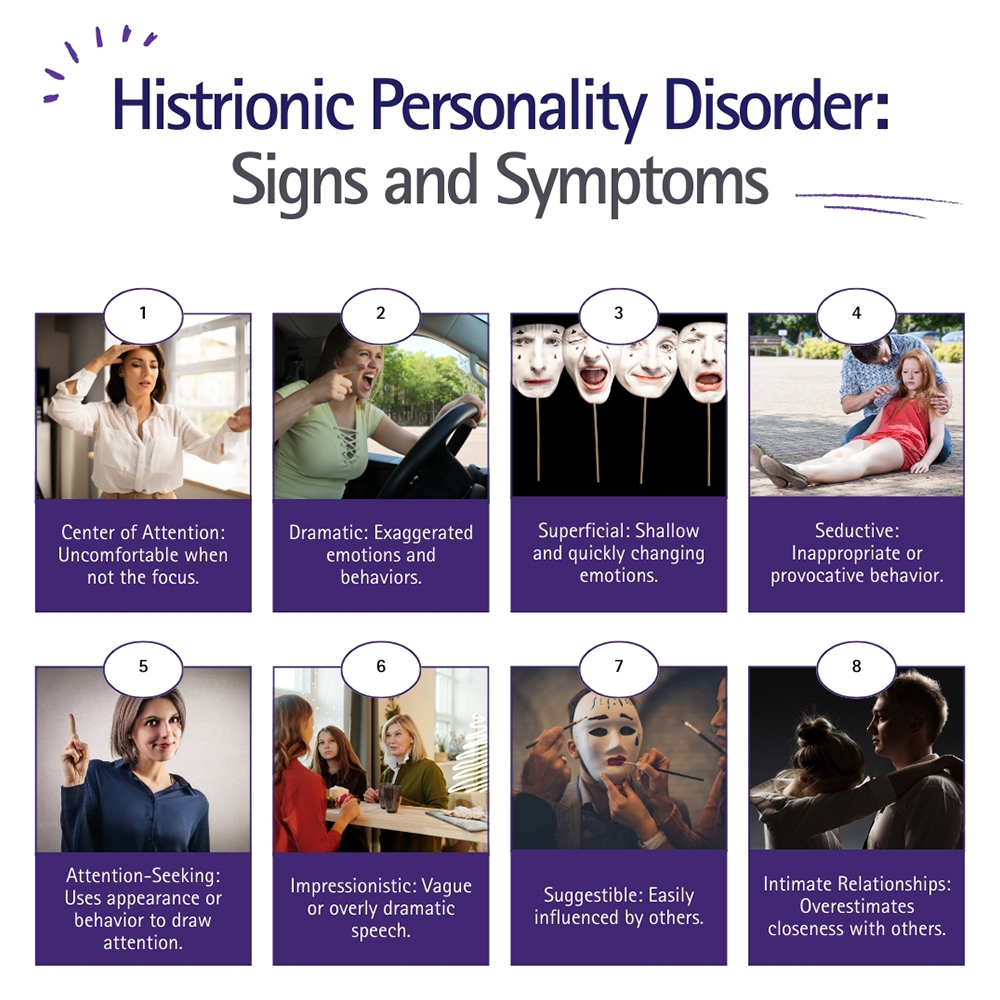
Symptoms of HPD include:
- Being uncomfortable in situations they are not the center of attention in
- Interactions with others are often characterized by inappropriate seductive or promiscuous behavior
- Rapid shift of emotions
- Using physical appearance to draw attention to self
- Speech that is impressionistic and lacking in detail
- Dramatic and emotional behavior
- Easily influenced
- Considering relationships to be more intimate than they are
Individuals with HPD may struggle to achieve emotional intimacy because on one level they may seek to manipulate their partners and on another level, they may be dependent on others.
Signs of HPD include:
- Excessive attention seeking
- Overly impressionable
- Difficulty with boundaries
- Inappropriately seductive
- Dramatic speech and expressions
- Easily bored
The presence of these signs and symptoms does not mean someone has HPD. A licensed clinician should diagnose HPD in a therapeutic setting.
Causes of Histrionic Personality Disorder
HPD can have several causes, including:
- Genetics: Individuals with a family history of HPD or other mental illnesses may be more likely to develop histrionic personality disorder.
- Trauma: Traumatic events in early childhood such as emotional abuse along with trauma bond or neglect, may contribute to the development of histrionic personality disorder.
- Modeling: Sometimes, individuals who have been raised by caregivers who have histrionic personality disorder tendencies may model this behavior.
Many people with HPD have a nervous system that has learned to stay externally focused and adjust their behavior to maintain safety.
Diagnosing HPD
HPD is diagnosed by a licensed and qualified mental health professional such as a psychotherapist or psychologist.
Your therapist can diagnose HPD in the following ways:
- Assessment: Your therapist will ask questions about your symptoms, family and personal history, and behaviors.
- Diagnostic criteria: The clinician may use diagnostic criteria from the Diagnostic and Statistical Manual (DSM-5) to assess your symptoms.
- Assessment tools: Counselors may use standardized assessment tools or questionnaires to help identify HPD traits.
- Differential diagnosis: Mental health specialists will consider other possible diagnoses or explanations for symptoms to rule out other diagnoses.
- Collateral information: With your permission, a psychotherapist may talk to your family members or loved ones to help diagnose and treat your condition.
Histrionic personality disorder must be diagnosed by a licensed clinical mental health provider. After diagnosis, you and your therapist will provide psychoeducation on how the nervous system works and help you come up with easy-to-use tools to regulate and feel more stable.
Treatment for Histrionic Personality Disorder
Treatment for Histrionic Personality Disorder (HPD) emphasizes interoception. When we experience stress at a young age, we tend to focus our attention on others, such as caregivers, to ensure that we are meeting their expectations and receiving the care we need. This tendency to focus on others becomes ingrained as a conditioned pattern in our nervous system.
At Evolve Therapy & Counseling, we provide treatment through the Sovereign Body Method™, a structured approach developed by Liz Chelak, LCSW.
This method focuses not only on gaining insight but also on:
- Relaxing your nervous system, helping it to stop being on high alert all the time
- Learning to listen to your own internal signal to decide what is right for you
- Decreasing reliance on others for validation
The goal is not to suppress your emotions but to use your feelings as guidance, allowing you to express them without being controlled by them.
Medications for HPD
Medications used to treat symptoms of HPD include:
- Antidepressants
- Mood stabilizers
- Antipsychotics
However, medication alone cannot treat HPD, and the best treatment is a combination of therapies.
Online Therapy for Histrionic Personality Disorder?
Online therapy is highly effective for HPD. According to the research, online therapy is just as effective as in-person therapy for personality disorders.
If you, or someone you know, is dealing with histrionic personality disorder, a nervous system-based approach is essential. Schedule an HPD therapy appointment in Brickell, Downtown Miami, and West Palm Beach by contacting Evolve Therapy & Counseling.